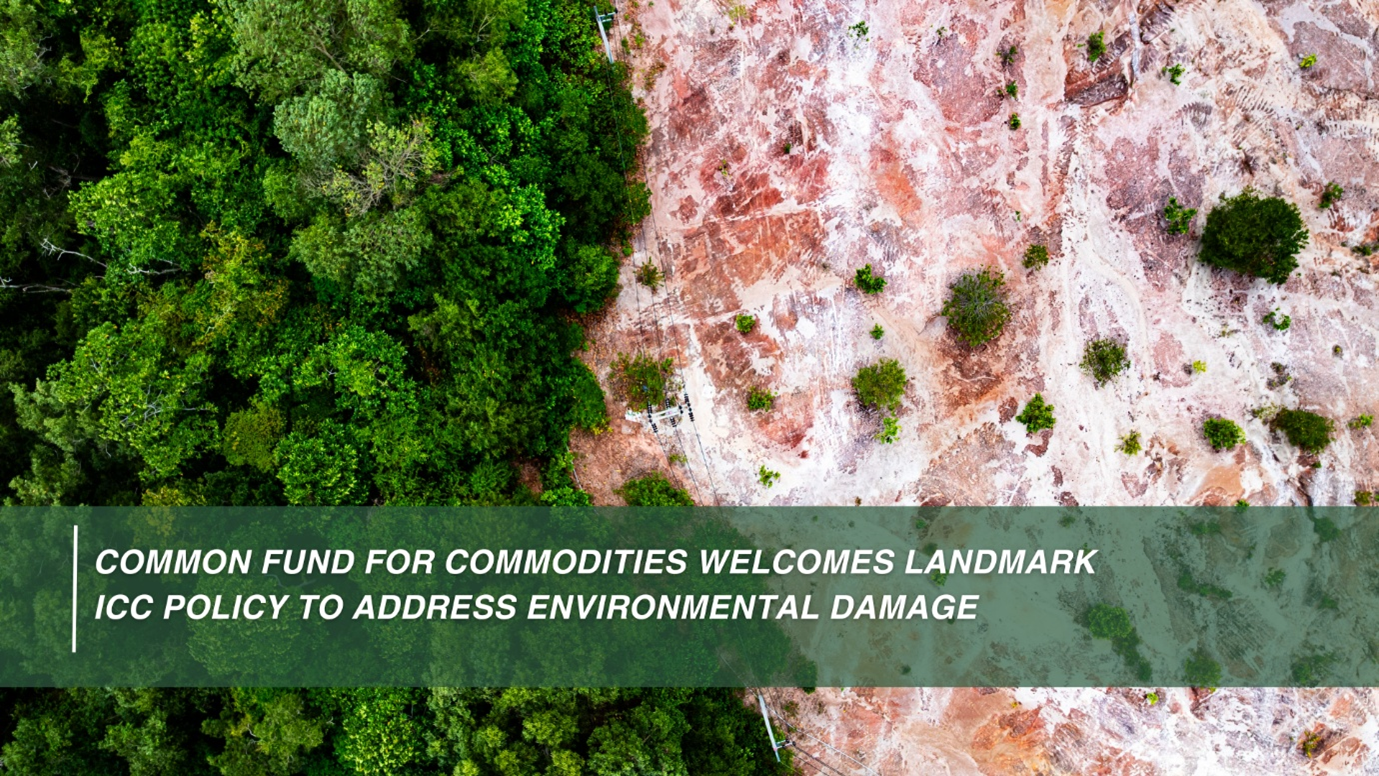
Common Fund for Commodities Welcomes Landmark ICC Policy to Address Environmental Damage
The Common Fund for Commodities (CFC) warmly welcomes the release of the Policy on Addressing Environmental Damage Through the Rome Statute issued by the Office of the Prosecutor of the International Criminal Court (ICC). This groundbreaking document represents a historic advance in recognising that grave environmental destruction is not only an ecological crisis—it is, unequivocally, a matter of global justice.
As outlined by the ICC Prosecutor, the Rome Statute provides a framework through which environmental destruction—when it results in or is used as a means to commit severe harm—may constitute genocide, crimes against humanity, war crimes, or aggression. The Policy highlights that environmental damage frequently strikes hardest at those already living on the margins: “Indigenous Peoples, women, children, people of African descent, peasants, and other vulnerable groups,” whose survival, dignity, and cultural identity are deeply intertwined with their natural surroundings.
At a time when hunger is rising and poverty is worsening across many regions, this Policy’s emphasis on environmental justice aligns profoundly with the CFC’s mission. In global value chains, environmental destruction is too often accompanied by illegal land dispossession, contaminated water sources, the destruction of crops, and unsustainable extraction of natural resources. Such acts, the ICC notes, may constitute crimes against humanity when they deprive communities of food, water, and the means essential for survival (Rome Statute, Article 7)
“When food is taken from the mouths of the hungry, when wells are poisoned, forests razed, or lands seized to the point that communities can no longer live or farm, this is not merely economic exploitation—it can be an international crime,” said Ambassador Sheikh Belal, Managing Director of CFC.
The ICC’s new Policy affirms that serious environmental damage—including widespread, long-term, or severe harm—can fall within the Court’s jurisdiction, emphasising the rights of present and future generations and the urgent need for prevention, accountability, and intergenerational equity.
The CFC applauds this development as a critical reinforcement of the global movement to humanise value chains. No commodity system, market structure, or economic model can be considered fair or sustainable if it is built on the suffering of the vulnerable or the destruction of the ecosystems that sustain them.
A Call to Action
The ICC’s Policy provides a powerful message to governments, corporations, investors, and all actors in global value chains: environmental destruction that harms communities is not a distant or abstract concern—it is a potential international crime with serious legal consequences.
As we advance our work to ensure fairness, dignity, and sustainability from farm to market, this Policy reinforces a collective moral and legal imperative:
Environmental justice is inseparable from economic justice.
And economic systems cannot be considered just if they sacrifice the rights and livelihoods of the world’s most vulnerable.
The CFC applauds Prosecutor Khan and his team for this timely, courageous, and forward-looking contribution to global justice.
Read the full ICC Policy here: Policy on Addressing Environmental Damage Through the Rome Statute