Ghana’s Cocoa Sector Doesn’t Need More Land, It Needs More Value
By: Bonifacius Dwi Laksono
Cocoa has been woven into Ghana’s economic and social fabric for nearly a century and a half. Since its introduction in 1879, cocoa has evolved from a promising crop into the country’s most important agricultural export and a cornerstone of rural livelihoods. Today, more than 800,000 households depend directly on cocoa production, the vast majority of them smallholder farmers concentrated in Ghana’s southern forest zones. Even as the national economy gradually diversifies into minerals, oil, and services, cocoa continues to play a defining role in export earnings, employment, and rural stability (ECORYS, 2022).
Discussions about the future of cocoa in Ghana often revolve around a familiar question: how can production be increased? For decades, higher yields and expanded acreage have been seen as the primary pathways to sustaining farmer incomes and national revenues. Yet, this focus on volume may no longer be appropriate. In fact, under current environmental and market conditions, asking how to produce more cocoa risks overlooking the deeper challenges facing the sector.
The climate challenge is largely a forest challenge
From a climate perspective, Ghanaian cocoa carries a relatively high footprint, approximately 9.8 kilograms of CO₂ equivalent per kilogram of cocoa produced. At first glance, this figure suggests an inherently carbon-intensive crop. However, a closer examination reveals a much more nuanced reality. Over 90 percent of these emissions are not generated by fertilizers, farm machinery, or on-farm energy use, but rather by deforestation linked to cocoa expansion (Carbon Cloud, n.d.).
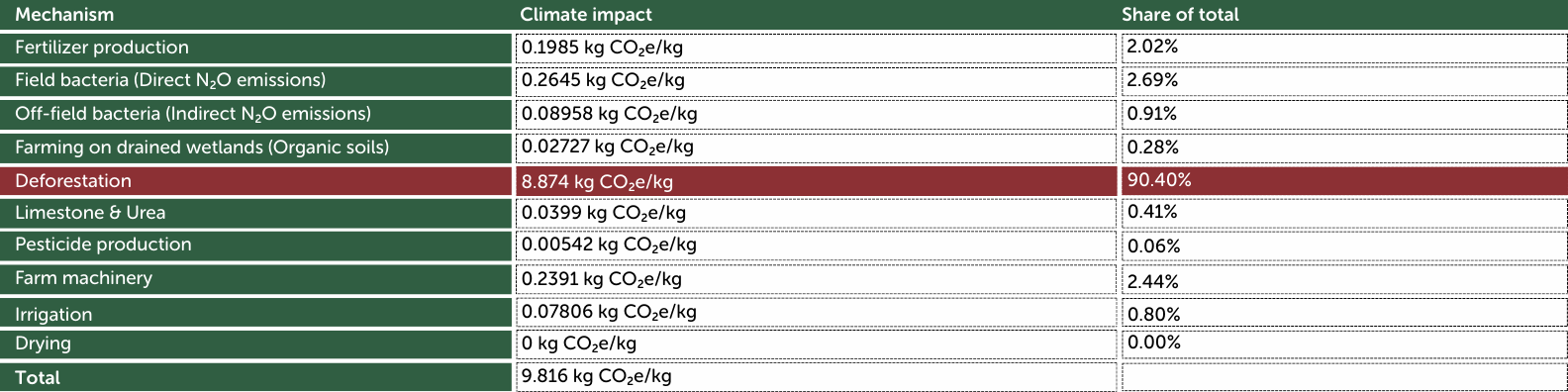
This distinction is crucial. Cocoa farming itself is not particularly emission-heavy when compared to many other agricultural commodities. Inputs such as fertilizers, pesticides, irrigation, and processing account for only a small fraction of total emissions. Instead, the dominant source of climate impact is land-use changes specifically, the conversion of forests into cocoa farms. When mature forests are cleared, the carbon stored in trees and soils is released into the atmosphere, creating a long-lasting climate burden.
Understanding this shifts the policy conversation entirely. The problem is not inefficient farming practices; it is where cocoa is grown. As suitable land becomes scarcer, continued expansion threatens remaining forest reserves, biodiversity, and ecosystem services. Moreover, with the introduction of deforestation-free supply chain regulations in key markets such as the European Union, forest loss has become a direct commercial risk. What was once framed as an environmental concern is now also a market access issue.
Processing capacity and the limits of supply
In response to long-standing concerns about exporting raw commodities, Ghana has invested heavily in domestic cocoa processing. The logic is compelling: processing cocoa into butter, liquor, and powder creates jobs, retains more value locally, and reduces dependence on volatile global prices. However, reality has proven more complex. Despite significant installed capacity, only about half of Ghana’s cocoa processing facilities are currently utilized, while domestic chocolate manufacturing remains marginal (ECORYS, 2022).
The core constraint is not technology or infrastructure, but access to affordable raw material. Light-crop cocoa beans, which are typically cheaper and better suited for processing, are in limited supply. Main-crop beans, by contrast, command higher prices on international markets and are often more profitably exported in raw form. As a result, processors struggle to secure sufficient volumes, leading to underutilized factories and missed opportunities.
This situation points to a broader structural issue: cocoa supply in Ghana is already under pressure. Attempting to resolve this bottleneck by simply increasing production risks, accelerating deforestation and undermining climate commitments. In other words, expanding supply through land conversion would worsen the very problem the sector is trying to solve.
Why “more cocoa” is not the solution
Rather than pursuing ever-higher volumes, Ghana’s cocoa sector would benefit more from extracting greater value from existing production. This shift from quantity to quality and diversification aligns with both environmental constraints and evolving market demand.
There is clear potential for small-scale, high-quality chocolate manufacturing within Ghana, particularly for niche and premium markets. Beyond chocolate, cocoa by-products offer additional opportunities. Cocoa shells, pulp, and butter can be used in food ingredients, cosmetics, soaps, animal feed, and other value-added products. These activities require far less land than new plantations, yet they generate employment, diversify income streams, and improve resilience against price volatility (ECORYS, 2022).
In the context of tightening land availability, climate stress, and stricter environmental regulations, a value-driven strategy is not only more sustainable, but also more realistic.
Leveraging GIS for smarter cocoa production
A persistent challenge within Ghana’s cocoa sector is traceability. Many cocoa farms are small, dispersed, and informally documented, making it difficult to track where beans originate and how they are produced. Geographic Information Systems (GIS) offer practical tools to address this gap.
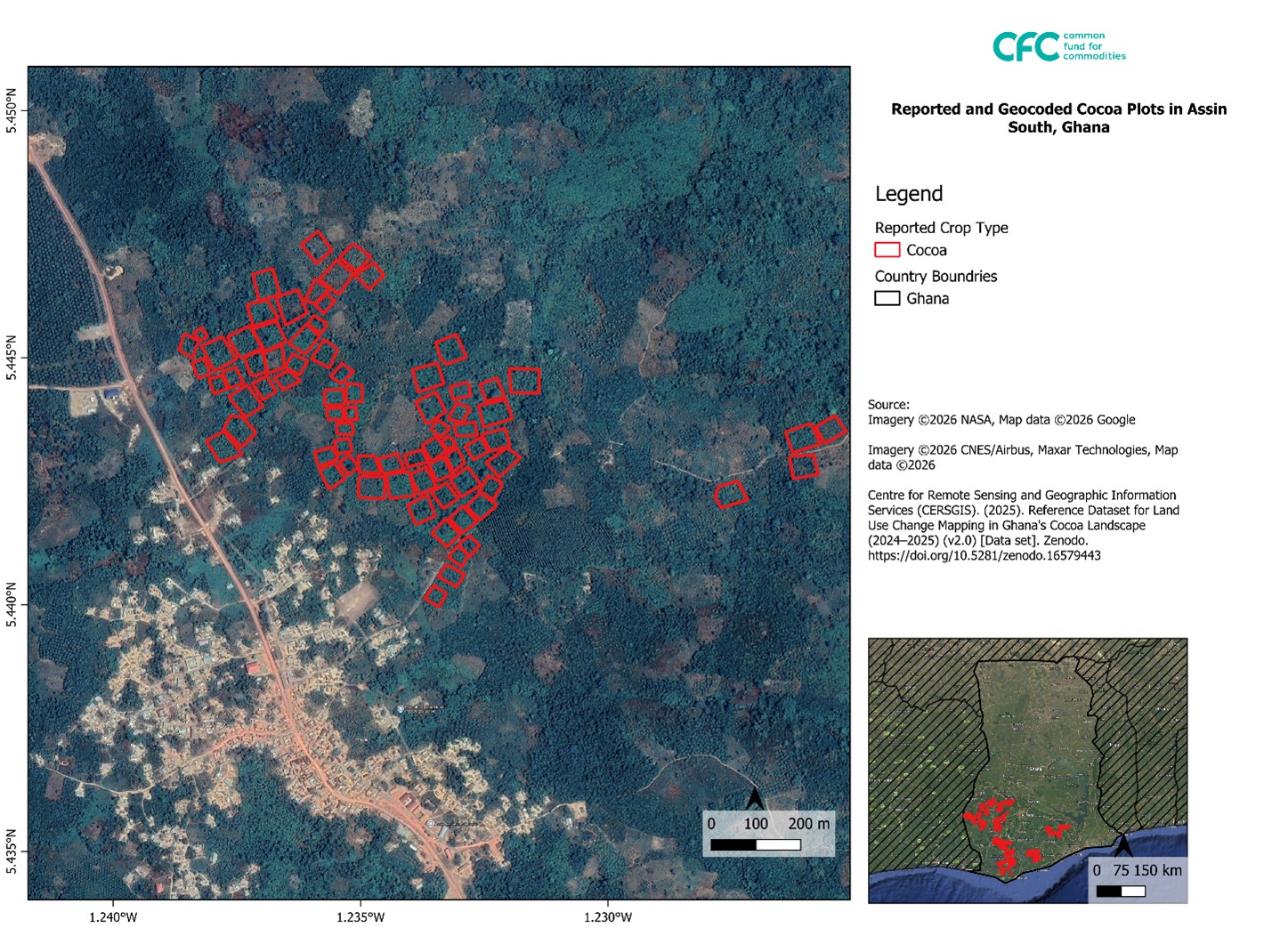
South Region of Ghana
Using public satellite imagery and cocoa reference maps, buyers and processors can better understand supply patterns and connect more efficiently with producers, particularly in regions such as Assin South where farms are fragmented. Improved traceability can reduce transaction costs, stabilize supply relationships, and support compliance with emerging deforestation-free regulations.
GIS also plays a critical role in forest protection. Platforms such as Global Forest Watch have identified regions in Ghana where cocoa-driven deforestation risks are highest. When these risk maps are combined with farm-level location data, policymakers and companies can prioritize interventions, support farmers in high-risk areas, and prevent further forest loss before it occurs (Global Forest Watch, 2023).
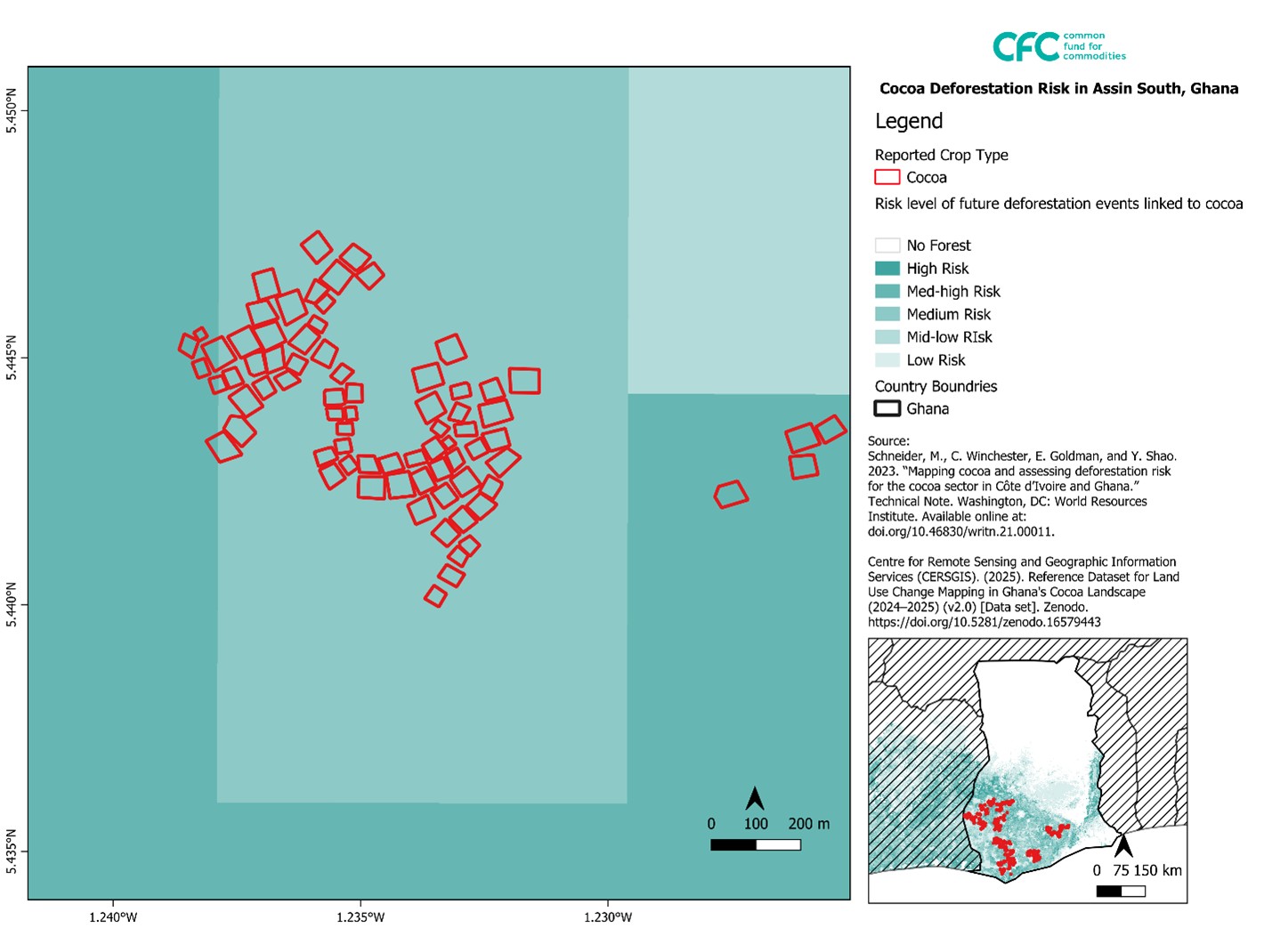
cocoa deforestation risk.
Embedding traceability standards early in the supply chain can therefore support not only environmental goals, but also inclusive and long-term market access.
Ghana’s cocoa sector stands at a crossroads. One path continues the historic emphasis on expanding production, even as land grows scarcer and environmental regulations tighten. The other prioritizes traceability, forest conservation, and value addition—creating greater economic returns without expanding farmland.
The evidence increasingly favors the latter. Ghana does not need more cocoa land. It needs better systems, smarter incentives, and a sharper focus on value creation. The most effective way to tackle poverty at the smallholder level is not through expansion, but through higher farm-gate returns—driven by value addition, credible traceability, and fairer transmission of prices along the value chain.
If these elements are aligned, cocoa can remain a vital source of livelihoods and national income without sacrificing the country’s remaining forests. The choice remains open, but only one path meaningfully serves both smallholders and sustainability.
References
CarbonCloud. (n.d.). Cocoa, Ghana · 9.82 kg CO₂e/kg | Verified by CarbonCloud. https://apps.carboncloud.com/climatehub/agricultural-reports/benchmarks/1c7ce7d5-4b34-4c5f-aa1d-484e296c33f5
Centre for Remote Sensing and Geographic Information Services (CERSGIS). Reference Dataset for Land Use Change Mapping in Ghana's Cocoa Landscape (2024–2025). v2.0, Zenodo, 29 July 2025, https://doi.org/10.5281/zenodo.16579443.
Schneider, M., C. Winchester, E. Goldman, and Y. Shao. 2023. “Mapping cocoa and assessing deforestation risk for the cocoa sector in Côte d’Ivoire and Ghana.” Technical Note. Washington, DC: World Resources Institute. Available online at: doi.org/10.46830/writn.21.00011.
ECORYS (2022) Cocoa Processing Study: Final Report. https://www.rvo.nl/files/file/2023-03/Cocoa-Processing-Study-Final-report.pdf
For media inquiries, please contact:
[CFC Media Relations Team]
[Email: managing.director@common-fund.org]
[Phone: +31 20 575 4949]