CFC Highlights Role of Local SMEs and Inclusive Finance in Building Sustainable Pathways Out of Poverty
Amsterdam, 19 October 2026 – The Common Fund for Commodities (CFC) hosted a webinar on 15 October 2026 in observance of the International Day for the Eradication of Poverty, bringing together diplomatic representatives, development finance experts and participants from around the world to explore how investment in small and medium-sized enterprises (SMEs) can strengthen smallholder livelihoods and address the structural causes of poverty.
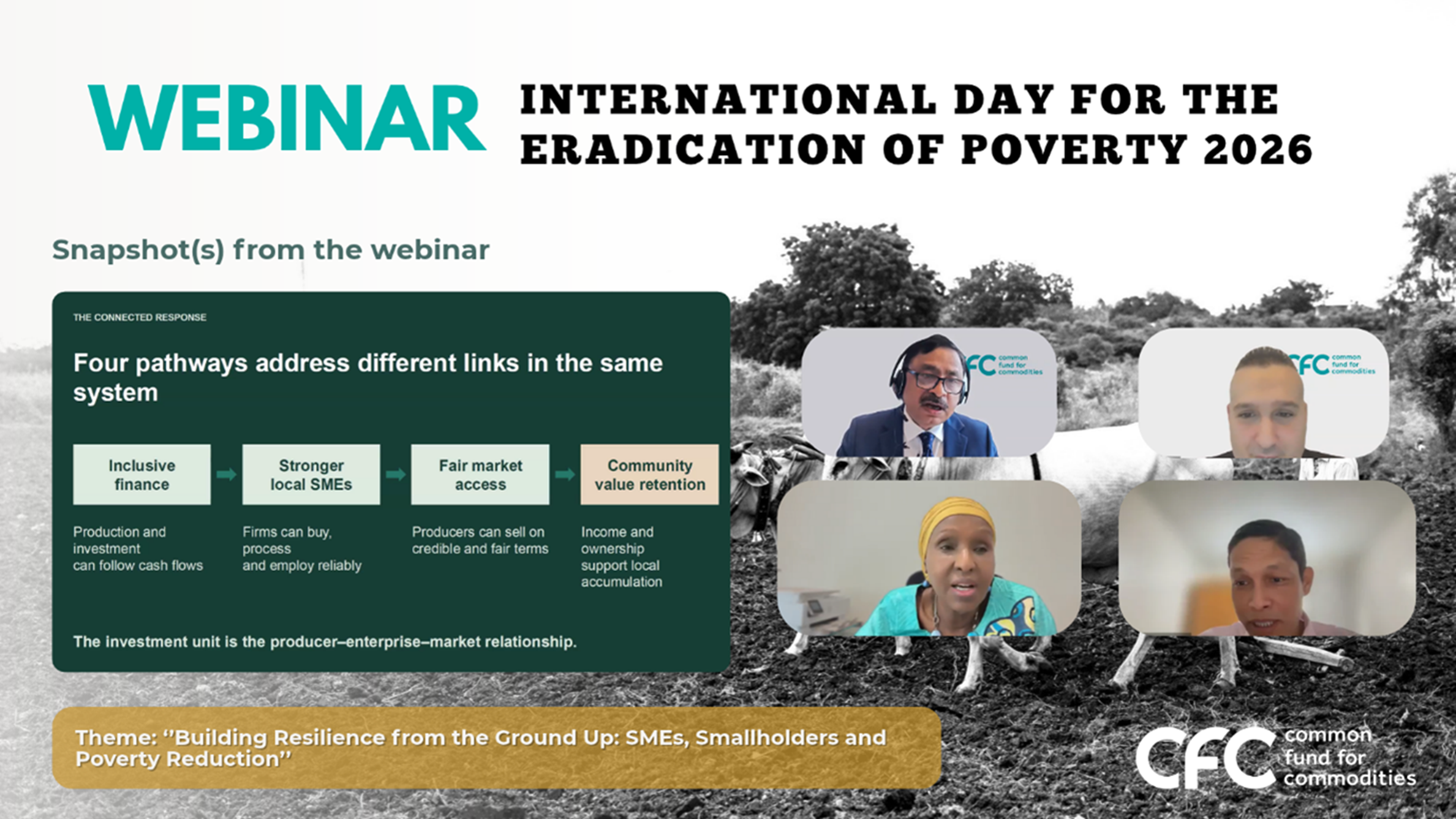
Held under the theme “Building Resilience from the Ground Up: SMEs, Smallholders and Poverty Reduction,” the webinar examined how inclusive finance, stronger local enterprises, fairer market access and greater retention of value in producing communities can create sustainable pathways out of poverty.
The discussion highlighted a central challenge: despite producing commodities of significant economic value, millions of smallholders continue to face limited access to finance, unreliable markets and insufficient opportunities to benefit from the value they create.
Moving beyond economic growth to household prosperity
Ambassador Sheikh Mohammed Belal, Managing Director of the CFC, opened the discussion by reflecting on the persistent contradiction between commodity wealth and rural poverty. Drawing on his recent visit to a commodity-producing community, he emphasized that national economic indicators do not necessarily reflect the realities experienced by vulnerable households. He called for a more human-centred approach to commodity development, in which progress is measured not only by production and export earnings, but also by improvements in household incomes, economic security and resilience. He underscored the CFC's commitment to Humanizing the Value Chains, ensuring that economic opportunities translate into tangible improvements in the lives of producers and their communities.
Building resilience in vulnerable communities
H.E. Dr. Khadija Ossoble Ali, Ambassador of the Federal Republic of Somalia to the European Union and Benelux, highlighted the challenges facing rural communities exposed to climate shocks, conflict and displacement.
Drawing on Somalia's experience, she emphasized that sustainable recovery requires more than immediate humanitarian assistance. It also depends on restoring productive assets, improving access to finance and strengthening the local businesses that connect farmers and pastoralists to markets.
She identified three priorities: protecting livelihoods before shocks cause permanent losses, investing in local SMEs and producer organizations, and humanizing value chains so that producers receive a fairer share of economic opportunities and rewards.
Her remarks reinforced the importance of building productive capacity and economic resilience alongside efforts to address immediate poverty and food insecurity.
Four pathways towards sustainable poverty reduction
Delivering the keynote presentation, “Financing Productive Transformation: The Missing Middle and Pathways Out of Poverty,” Professor Suborna Barua, Professor at the University of Dhaka and Visiting Research Fellow at the University of Leeds, examined how development finance can help transform commodity-producing economies.
Professor Barua highlighted the financing challenges faced by agricultural SMEs and cooperatives, often referred to as the “missing middle.” These enterprises play a vital role in connecting smallholder farmers to markets, processing agricultural products, creating employment and supporting local value addition, yet frequently struggle to access suitable financing.
His presentation outlined four interconnected pathways for creating more inclusive and resilient commodity value chains:
- Inclusive finance: Providing financing that responds to producers' cash flows and investment needs, enabling productive investment and sustainable growth.
- Stronger local SMEs: Supporting enterprises that can reliably purchase, process and market agricultural products while creating employment and strengthening local economies.
- Fair market access: Ensuring that smallholders can sell their products under credible and fair commercial arrangements.
- Community value retention: Enabling more income, ownership opportunities and economic benefits to remain within producing communities, supporting local reinvestment and wealth creation.
Rather than treating these as separate interventions, Professor Barua emphasized that they should reinforce one another.
“The investment unit is the producer–enterprise–market relationship,” his presentation concluded, highlighting the need to connect suitable finance, commercially viable enterprises and fair market arrangements with measurable improvements in household livelihoods.
He further emphasized that increasing production alone is insufficient. Sustainable poverty reduction requires improvements in net household income, productive capabilities and the ability of communities to reinvest in their own development.
From investment to impact: The experience of Westend Farms in Cameroon
The relevance of these approaches can be illustrated through Westend Farms, a CFC-supported agribusiness in Cameroon, led by its Managing Director, Mr. Julius Manjoh.
Westend Farms operates across the agricultural value chain, from maize and soybean production and animal feed processing to pig farming, meat processing and retail distribution. Beyond its commercial activities, the company contributes to rural development through direct employment and partnerships with smallholder farmers.
The company currently employs 187 people, spending approximately USD 600,000 annually on salaries. Through its smallholder maize sourcing initiative, it also provides farmers in neighbouring villages with a reliable buyer, crop collection services and payments within seven days.
Its maize purchases from smallholders increased from 95 metric tonnes in 2024 to 1,572 metric tonnes in 2025, demonstrating how dependable market access can stimulate local agricultural production and create economic opportunities.
The company's experience also illustrates the importance of flexible development financing. In 2023, an outbreak of African swine fever wiped out its entire pig stock, severely disrupting operations. During this period, the CFC supported the company's recovery through a temporary suspension of debt servicing and an interest holiday. Westend Farms has since recovered and fully repaid its outstanding debt.
The experience demonstrates how investment in local enterprises, combined with appropriate financial support, can strengthen business resilience while sustaining employment and generating wider benefits for smallholder communities.
Connecting finance, enterprises and fair markets
The webinar concluded by emphasizing that sustainable poverty reduction requires coordinated action across the entire commodity value chain.
Access to finance must enable productive investment; local SMEs must have the capacity to connect farmers with reliable markets; and the benefits of economic activity must translate into improved household incomes, decent employment and greater community resilience.
These priorities closely align with the CFC's commitment to Humanizing Value Chains, advancing an approach to development in which the people who produce commodities can participate more equitably in the prosperity generated from their work.
As Professor Barua's keynote summarized, the objective is to enable producing communities to:
“Earn more. Retain a fairer share. Reinvest in a more secure future.”
The CFC remains committed to working with governments, development institutions, private enterprises and producer organizations to translate these principles into practical investments that strengthen local economies and create lasting pathways out of poverty.