ICAC Managing Director Visits CFC to Discuss Regenerative Cotton and Carbon Finance
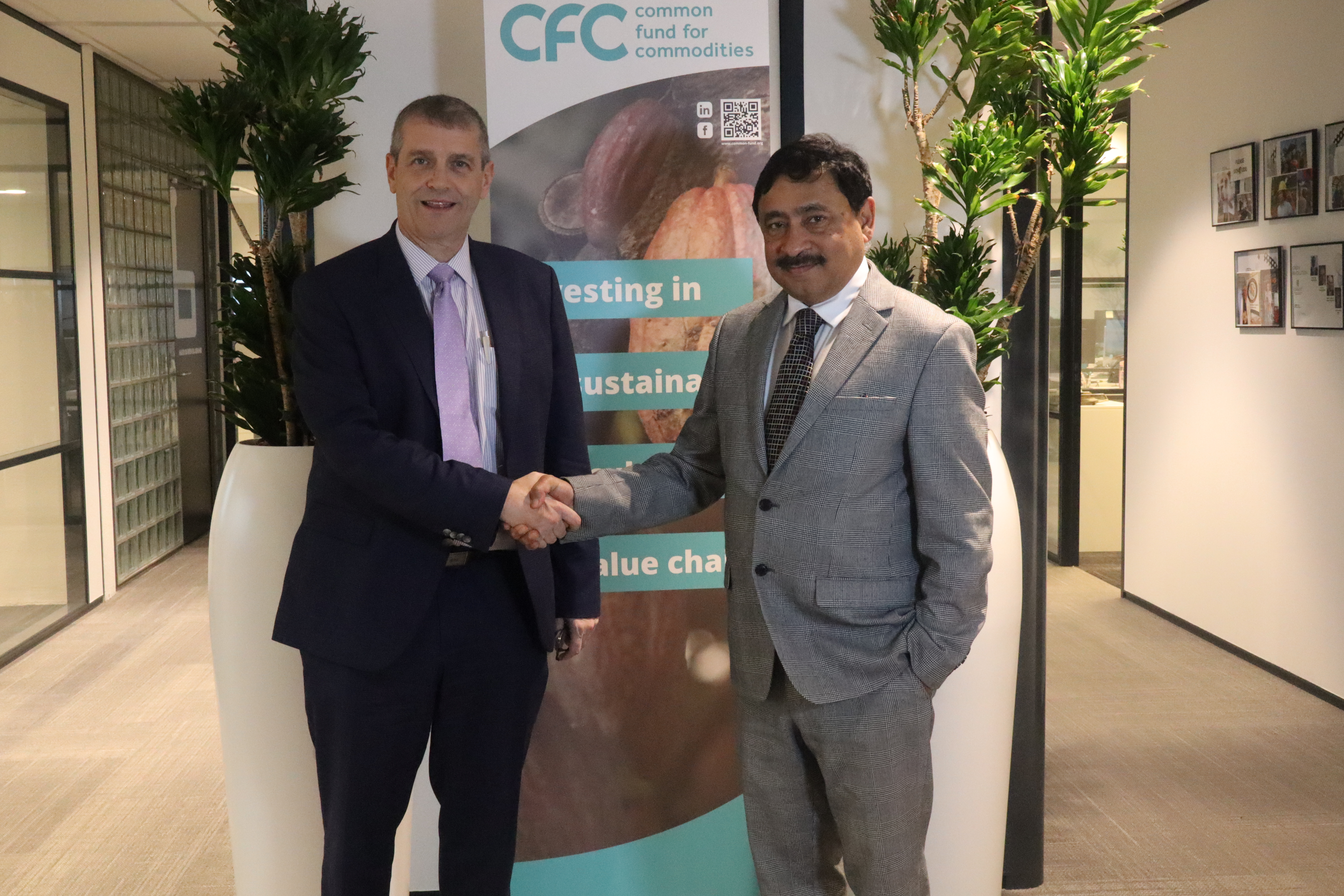
Amsterdam, 27 October 2026 – The Common Fund for Commodities (CFC) Managing Director, Ambassador Sheikh Mohammed Belal accompanied by Chief Operating Officer Mr. Nicolaus Cromme, met with thto explore opportunities to scale regenerative cotton production through innovative financing mechanisms, carbon-credit generation and farmer-centred approaches that make sustainable agriculture commercially viable.
Discussions focused on regenerative cotton initiatives that incorporate biochar production and use, offering opportunities to improve agricultural practices while generating carbon credits. The approach has been successfully implemented in countries including Zambia, Uzbekistan and Cameroon, with potential for expansion into other regions and agricultural value chains.
Turning regenerative agriculture into an economic opportunity for farmers
A central theme of the discussion was the need to put farmers at the heart of the transition to regenerative agriculture. While sustainable farming practices can deliver environmental benefits, their adoption often requires upfront investment, changes in established farming methods and a willingness to take on new risks. For smallholder farmers in particular, the transition must offer a clear and tangible economic benefit.
Carbon finance could help bridge this gap. Depending on the methodology, certification requirements, market conditions and transaction costs, carbon credits can command market prices of around USD 100 per tonne of CO₂ equivalent in certain segments of the voluntary carbon market. This illustrates the potential value of high-integrity carbon projects, although actual prices vary considerably by project type, quality and buyer demand.
Expanding the approach across commodity value chains
Although the current focus is on cotton, the principles underpinning this model could also be applied to other cash crops, including coffee. Extending regenerative practices and carbon-financing mechanisms across different commodities could create new investment opportunities, diversify farmers' income sources and support the transition towards more resilient and sustainable agricultural systems.
The discussion also provided an opportunity to consider how these approaches could complement the CFC’s ongoing efforts to promote sustainable commodity value chains and strengthen the economic opportunities available to smallholder farmers. By exploring the links between regenerative agricultural practices, carbon-credit markets and innovative financing, the exchange highlighted potential avenues for addressing the upfront costs of adopting more sustainable production methods while creating additional income opportunities for farmers.
Greater access to credible carbon-credit markets could help incentivise the adoption of regenerative practices, provided that the resulting revenues translate into tangible benefits for farmers. In this context, transparent benefit-sharing arrangements, robust verification and commercially viable financing structures are important to ensuring that environmental value is recognised and that farmers are fairly rewarded for their contribution. These approaches could complement the CFC’s broader impact investment mandate by helping identify opportunities to mobilise capital, support investment-ready commodity enterprises and promote more resilient, commercially sustainable agricultural value chains.
The meeting also touched on the Global Cotton, Textiles and Investment Summit, scheduled for 17–20 September 2027, as a potential platform to advance dialogue on investment, innovation and sustainability across the cotton and textile sectors.