[ZK1.1]CFC and South Centre Explore Cross-Border VAT Revenue Recycling for Fairer Commodity Value Chains
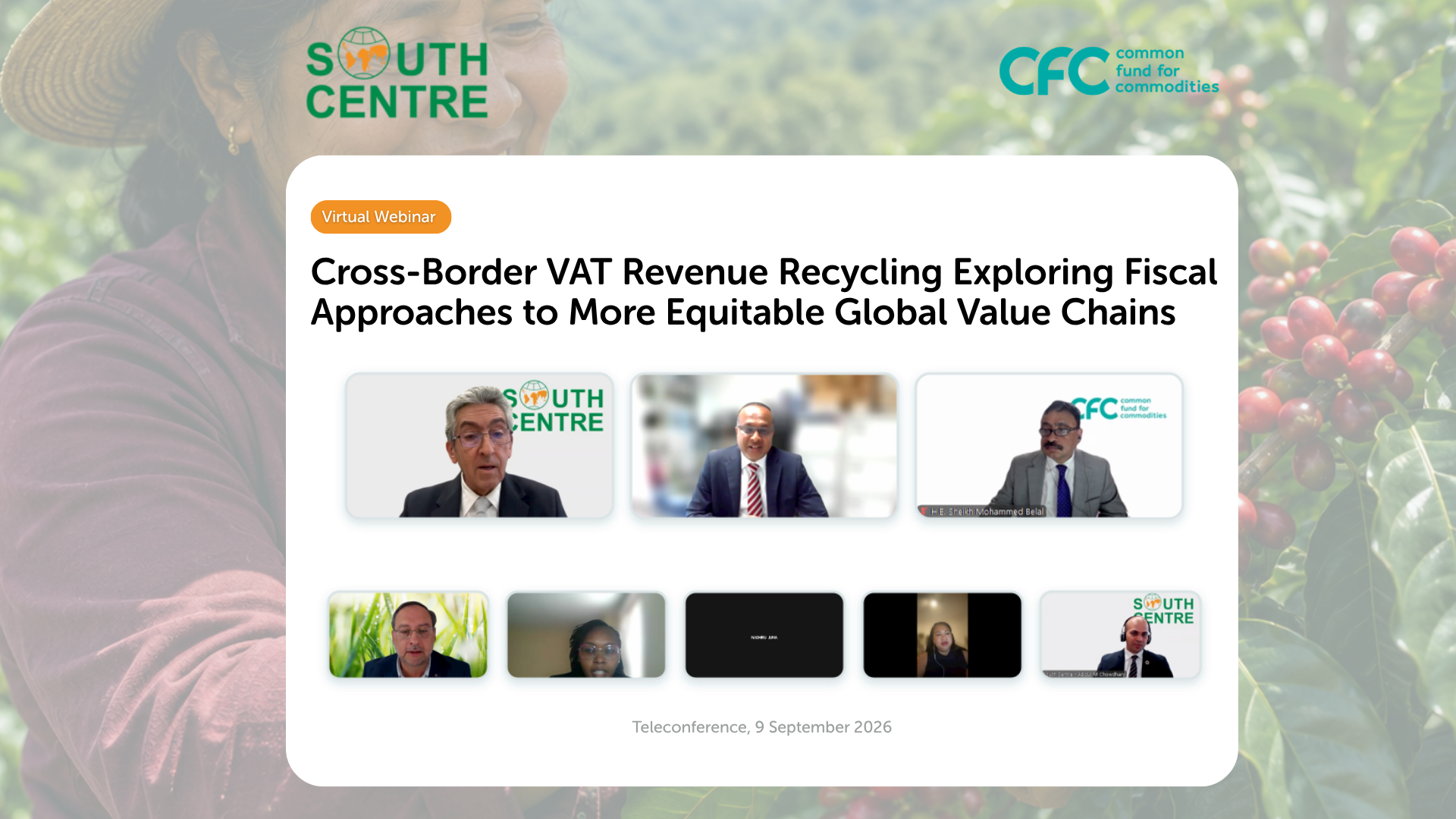
The Common Fund for Commodities (CFC) and the South Centre co-organized a webinar on 9 September 2026 to explore an innovative fiscal approach aimed at making global commodity value chains more equitable.
The webinar, “Cross-Border VAT Revenue Recycling: Exploring Fiscal Approaches to More Equitable Global Value Chains,” brought together tax officials, policy experts and academia to examine an exploratory proposal developed by the CFC on cross-border Value Added Tax (VAT) revenue recycling.
The webinar was inaugurated by Dr. Carlos Correa, Executive Director of the South Centre, followed by opening remarks from H.E. Ambassador R.G.S. Wijesekara, Ambassador of Sri Lanka to the World Trade Organization. Ambassador Sheikh Mohammed Belal, Managing Director of the Common Fund for Commodities, then presented the CFC proposal.
At the heart of the concept is a fundamental question: when a commodity is produced in one country but consumed in another, could a share of the fiscal value generated through final consumption help support the communities where production begins?
Under current VAT systems, revenues generally accrue where final consumption takes place. Yet much of the labour and natural resources embodied in commodities originate in developing countries, while significant economic value is generated downstream through processing, branding, distribution and retail. The CFC presentation notes that VAT is collected where final consumption occurs, with the importing country retaining that fiscal revenue even though part of the underlying value originates in producing countries.
The CFC proposal therefore explores whether a small share of VAT revenue generated through final consumption could be recycled to producing countries, helping support the farmers, workers and communities whose labour and resources underpin global consumption.
From value creation to value sharing
Cross-border VAT revenue recycling would not require a redesign of VAT itself. Instead, the concept explores whether participating consumer countries could recycle a limited share of revenues associated with final consumption back to producing countries through an accountable mechanism.
The proposal is intended to complement, rather than replace, existing approaches to fairer value chains, including Fairtrade and certification schemes, living-income approaches, greater transparency and traceability, and efforts to increase local value addition. The CFC concept paper explicitly describes VAT revenue recycling as a complementary redistributive tool rather than a substitute for corporate tax reform or market-based income improvements.
It also builds on CFC’s broader Humanizing the Value Chains initiative, which is grounded in the principle that those who create value should share more fairly in the prosperity generated along the chain. The initiative considers how reinvestment at origin can strengthen incomes, resilience and local value addition.
What could it mean in practice?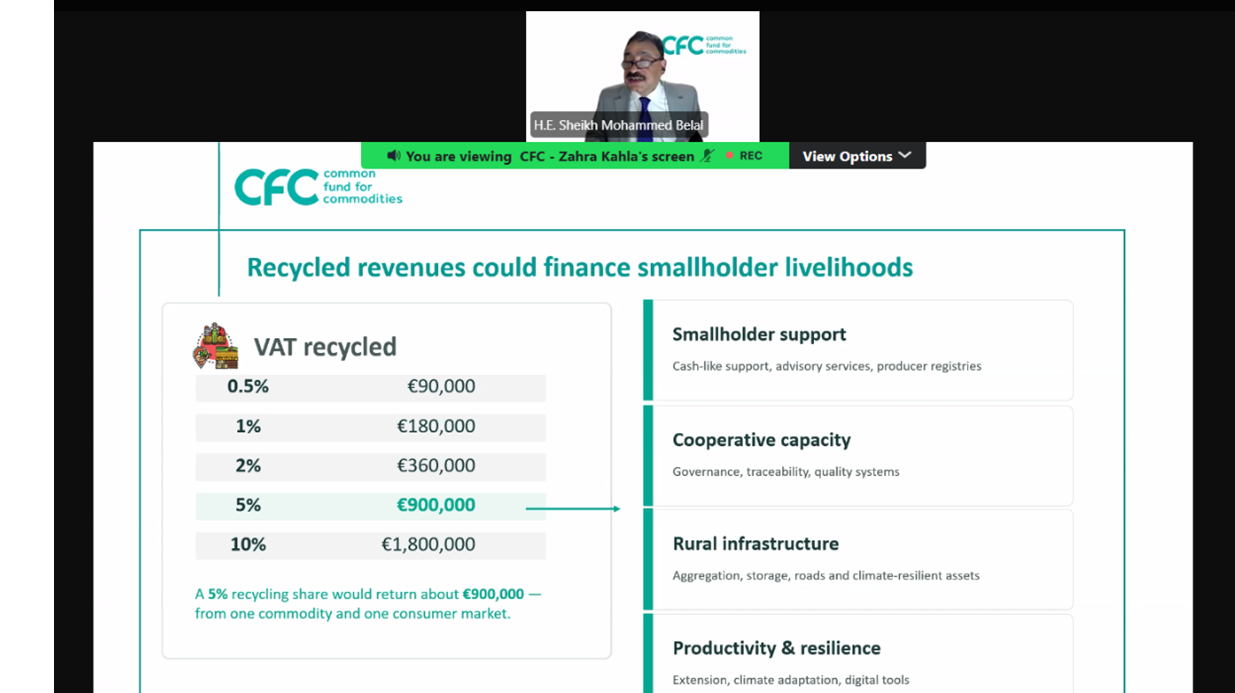
The potential scale of the approach was illustrated through the case of Peruvian avocados consumed in the Netherlands. CFC’s illustrative analysis estimated that approximately €18 million in VAT was associated with Peruvian avocados in the Netherlands in 2024. Recycling just 5% of this amount could generate around €900,000 for the producing country — from one commodity in one consumer market alone.
The figures are illustrative and would require further analysis and verified data, but they demonstrate the potential scale of the concept. Importantly, the approach is conceived not as an increase in VAT rates, but as a mechanism for exploring how a modest share of existing consumption-generated public revenue could be reinvested at origin.
Such resources could potentially support smallholder livelihoods, cooperative capacity, rural infrastructure, productivity and climate resilience. The CFC concept identifies possible uses ranging from advisory services and producer registries to storage, roads, climate-resilient assets, extension services and digital tools.
 Bringing developing-country perspectives to the discussion
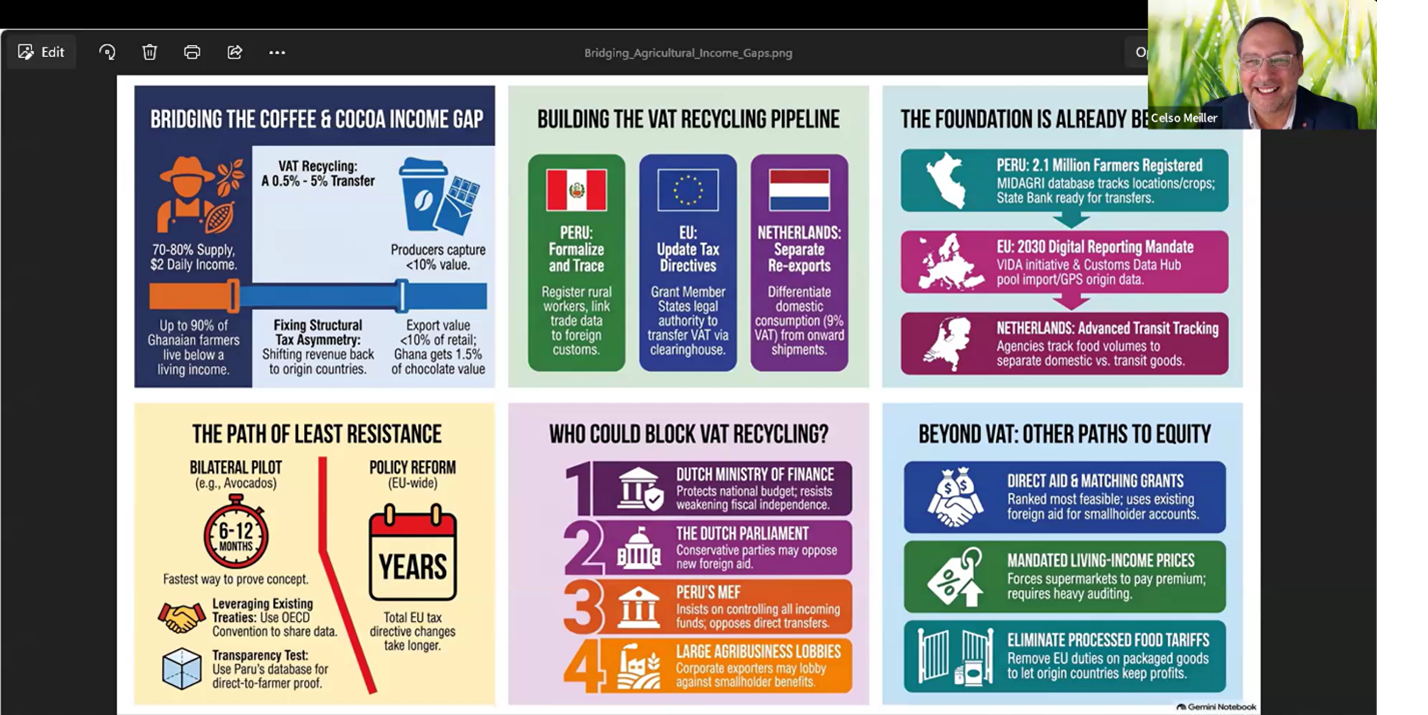
Following Ambassador Belal’s presentation, tax officials from South Centre Member States and an academic from Peru discussed the technical, legal, administrative and political feasibility of the proposal.
The discussion examined some of the central questions that would need to be addressed before such an approach could move towards implementation, including fiscal sovereignty, legal compatibility, data requirements, governance, transparency and accountability.
Turning an idea into a testable proposition
CFC emphasized that the concept remains exploratory and that considerable work would be required before practical implementation could be considered.
The CFC concept paper identifies political acceptability, fiscal sovereignty and administration among the principal design considerations. It proposes keeping any revenue share modest, using narrow product scopes, pilots and sunset clauses, framing the mechanism as an earmarked transfer rather than a VAT redesign, and using customs and VAT data alongside standardized reporting and reconciliation. It also emphasizes allocation criteria, safeguards, audits and transparency.
Closing the webinar, Ambassador Belal called for the discussion to move into a new phase of analysis and testing:
“The CFC has not presented a finished formula today. We have sought to do something equally important: to spark a serious debate about whether a modest share of the public revenue generated by global consumption can help sustain the people and places where production begins.”
He invited governments, tax and trade experts, development institutions and producer organizations to continue examining, challenging and testing the idea through carefully designed approaches.
The webinar concluded by highlighting a broader question at the heart of the proposal: as goods, value and risks already move across borders, could mechanisms for fairer value sharing and shared prosperity do so as well?
All News
About the Common Fund for Commodities (CFC)
The CFC is an UN-affiliated international financial institution based in Amsterdam, working in over 100 countries to support inclusive economic development through impact investing in commodity value chains.
For media inquiries, please contact:
[CFC Media Relations Team]
[Email: managing.director@common-fund.org]
[Phone: +31 20 575 4949]