Turning Commodity Wealth into Human Prosperity: Member States Champion CFC 2.0
The Hague, 17 November 2026 —The Common Fund for Commodities (CFC) concluded its 38th Annual Meeting of the Governing Council in The Hague, reaffirming strong Member State support for the Fund's transformation into a more effective and innovative development finance institution, CFC 2.0.
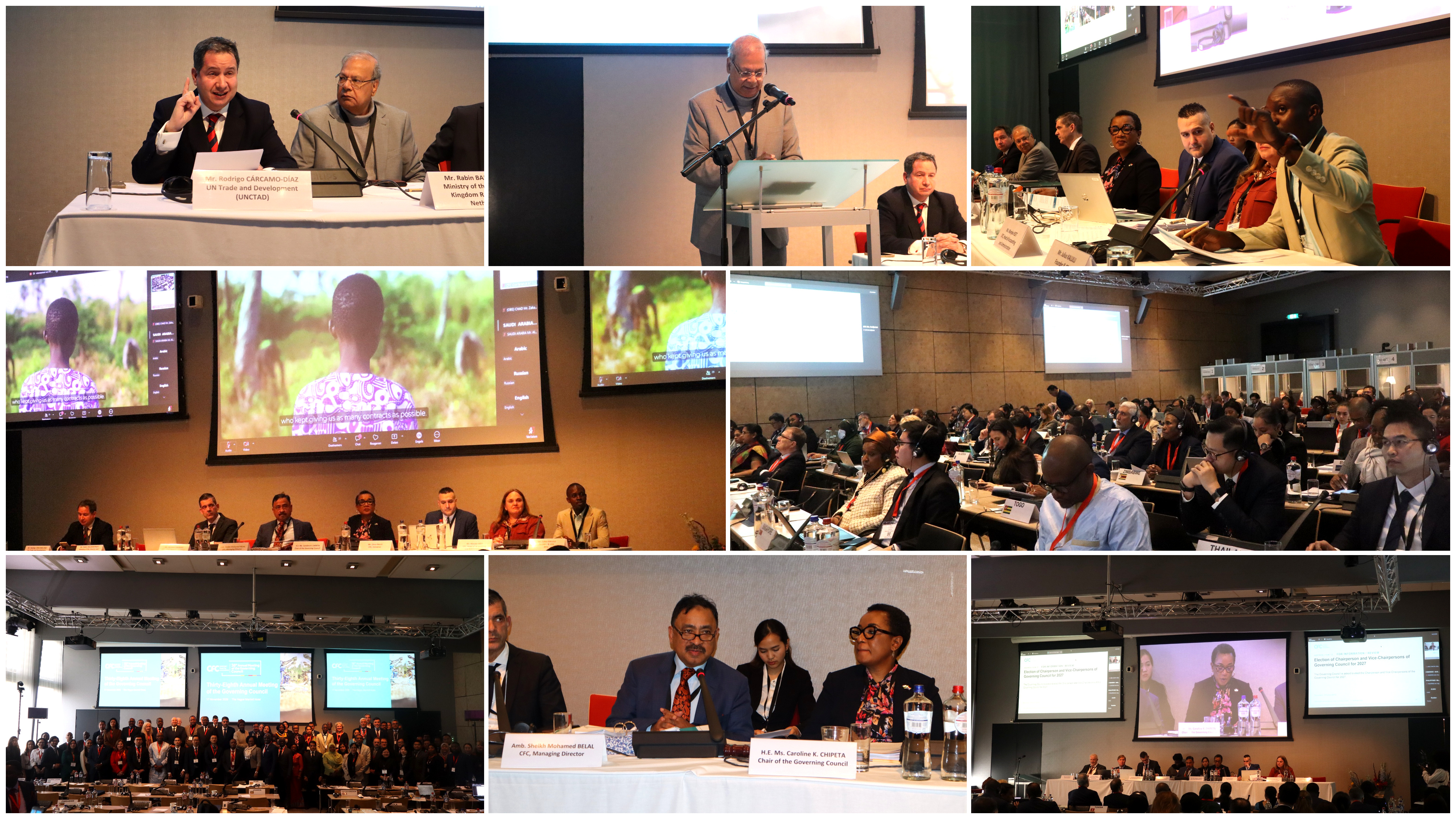
Chaired by H.E. Ms. Caroline Kitana Chipeta, Ambassador of the United Republic of Tanzania to the Netherlands, the meeting brought together 142 delegates, including six observers, representing 74 countries. A record 39 national statements reflected growing engagement with the CFC and expectations for its expanded contribution to sustainable and inclusive commodity development.
UNCTAD Reaffirms Its Partnership with the CFC
The Governing Council opened with an inaugural address on behalf of Mr. Pedro Manuel Moreno, Acting Secretary-General of UN Trade and Development (UNCTAD), delivered by Mr. Rodrigo Cárcamo-Díaz, Chief a.i. of the Agricultural Commodities Section, Division on International Trade and Commodities.
The address highlighted persistent challenges facing commodity-dependent developing countries, including price volatility, limited productive capacities and unequal participation in global value chains. It recognised the CFC's distinctive role in translating development priorities into tangible improvements in production, incomes and livelihoods, while reaffirming UNCTAD's commitment to strengthening their longstanding partnership.
Placing Human Dignity at the Centre of Commodity Development
In a thought-provoking keynote address, Mr. Rabin Baldewsingh, National Coordinator against Discrimination and Racism of the Netherlands, connected poverty, inequality and discrimination with the broader pursuit of human dignity.
Drawing on the recent Fifth UNESCO Global Forum Against Racism and Discrimination in The Hague, he invited reflection on the circumstances of smallholder farmers whose labour sustains global commodity trade but whose livelihoods often remain precarious.
His message resonated with the CFC's vision of Humanizing the Value Chains (HVC), which seeks to ensure that economic progress is measured not merely by trade and investment, but also by fairness, dignity and improved livelihoods for those at the origin of global value chains.
From Investment to Human Transformation: The JKCC Story
In his statement, Ambassador Sheikh Mohammed Belal, Managing Director of the CFC, outlined the Fund's institutional transformation, highlighting the entry into force of the amended Agreement Establishing the CFC, the adoption of its Strategic Framework 2025–2035, strengthened operational capacities and expanding investment partnerships.
To illustrate the human impact of these achievements, he engaged in a dialogue with Mr. Julius Kalulu, Founder and CEO of JKCC (Just Know Your Coffee Cup), a CFC-supported coffee enterprise in Uganda.
Mr. Kalulu recounted how JKCC had grown from an annual turnover of USD 130,000 in 2017 to nearly USD 79.8 million in 2026. Yet the most compelling transformation extended beyond the company's financial success.
Through 97 farmer cooperatives and groups involving more than 10,000 smallholders, JKCC has helped transform livelihoods across rural communities. Families once struggling with poverty are now building permanent brick houses, raising livestock, including Friesian dairy cows, and keeping poultry. The use of animal manure is also supporting the transition towards organic and more sustainable farming practices.
Reflecting on the CFC's support, Mr. Kalulu observed:
"But the CFC looked at us and saw potential. They didn't just see a business; they saw the human beings at the end of the value chain. They didn't just give us money; they gave us trust."
The exchange captured a central message of the Managing Director's statement: the true measure of development finance is not merely how much a business grows, but how many lives grow with it.
National Statements: Strong Support and an Appeal for Greater Resources
The record number of national statements conveyed broad recognition of the CFC's institutional reforms, growing operational effectiveness and expanding development impact. Member States encouraged the Fund to do more for commodity-dependent developing countries, particularly least developed countries, smallholders and local enterprises, while emphasising that these expectations must be matched by adequate financial resources.
References to paragraph 46(d) of the Sevilla Commitment, which encourages increased voluntary contributions to the CFC, featured prominently across national statements, reinforcing the importance of international support for agricultural development, local value addition and processing.
An overwhelming majority of Member States also expressed deep regret over the withdrawal notices submitted by Sweden and Norway, scheduled to take effect in September 2027. While fully recognising every Member State's sovereign right to withdraw, delegations appealed for continued engagement and reconsideration in light of the CFC's substantial institutional transformation.
The statements reflected an important distinction between earlier periods of institutional difficulty and the present circumstances, in which the reformed CFC is demonstrating stronger performance, expanding partnerships and growing demand for its services.
That demand is considerable. Across its ten most recent calls for proposals, the CFC received 2,404 applications requesting approximately USD 2.38 billion, compared with 83 approved projects receiving around USD 79 million in CFC financing commitments—equivalent to only 3.3% of the funding requested. Applications in 2026 reached 923, while an estimated 366 investment-ready projects requiring approximately USD 520 million remain without financing.
These figures underline the gap between available resources and the opportunities to support viable enterprises and transform livelihoods.
The collective message was one of confidence and urgency: at a time when the CFC is better positioned to fulfil its founding mandate, stronger financial support and continued international cooperation are needed to enable it to reach more communities and deliver greater development impact.
Advancing CFC 2.0 Through Stronger Partnerships
The Governing Council reviewed the Fund's continued progress in implementing its Strategic Framework 2025–2035 and strengthening its financing capacity.
During 2025–2026, the CFC mobilised approximately USD 84 million in additional resources and investment commitments, reflecting growing confidence among governments, development partners and private investors in its capacity to deliver measurable results.
The Fund's expanding partnerships and innovative financing arrangements are intended to address the persistent financing gaps confronting agricultural SMEs, promote local value addition and build more resilient and equitable commodity value chains.
Governing Council Leadership for 2027
The Governing Council re-elected H.E. Ms. Caroline Kitana Chipeta, Ambassador of Tanzania to the Netherlands, as Chairperson for 2027.
It also elected the following Vice-Chairpersons, nominated by their respective groups:
- African Regional Group: H.E. Ms. Mirjam Blaak Sow, Ambassador of Uganda to the Benelux countries.
- Asia and Pacific Regional Group: H.E. Ms. Sewa Lamsal, Ambassador of Nepal to the Benelux countries.
- Latin American and Caribbean Regional Group: H.E. Dr. Héctor Constant Rosales, Ambassador of Venezuela to the Netherlands.
- China: Mr. Jin Yuan, Counsellor, Embassy of China.
- Russian Federation: Ms. Evgenia Drozhashchikh, Deputy Director, Ministry of Economic Development of the Russian Federation.
- OECD Group: Nomination to be confirmed.
The Council expressed appreciation for the Chairperson's leadership and the continued contributions of Member States.
Looking Ahead: Turning Confidence into Greater Impact
As the CFC prepares for 2027, Member States will continue to guide the implementation of its long-term strategic vision, strengthen partnerships and support resource mobilisation. The 39th Governing Council will also elect the Fund's next Managing Director, marking an important milestone in its institutional development.
The 38th Governing Council concluded with a clear message: the CFC's transformation has created new opportunities to serve commodity-dependent developing countries. Sustaining that progress will require renewed commitment, stronger partnerships and financial contributions commensurate with the growing demand for its services.
Ultimately, the success of CFC 2.0 will be measured by the opportunities it creates for smallholders, workers and local enterprises—and by its contribution to ensuring that the wealth generated through global commodity trade translates into greater prosperity and dignity for those who produce it.
About the Common Fund for Commodities
The Common Fund for Commodities (CFC) is an autonomous intergovernmental financial institution established within the framework of the United Nations. With 101 Member States and nine institutional members, the CFC supports commodity-dependent developing countries through investments in sustainable agricultural enterprises, inclusive value chains and innovative development financing.